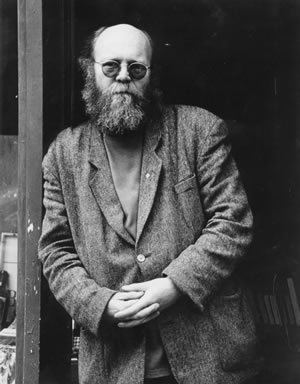
[Image: Clive Woods. © Richard Heald, 2006]
His journey has indeed been a surprising one, from the Mining and Technical College in Wigan to Lancaster University; to Kingston, Jamaica on a “Study and Serve” scheme; back to this country and Saltaire via Birmingham. His travels have always been determined more by chance than by planning: Had he not been inspired by Joe Hilton, a Catholic priest who was also an enthusiastic historian, he would never have done a History degree; without which he would never have found himself the only male teacher at St. Andrew’s High School for Girls in Jamaica. Had he not had a good friend in Larry Anderson, an educational psychologist from Bradford, he would not have been drawn to this area.
Finally, it was a chance remark by a Dr. Parker in Leeds that led him to look at the impact that Titus Salt had on the occupational diseases of the nineteenth century.
Clive left teaching to become a bookshop owner and researcher in Saltaire in 1986. Funding came from the royalties on his Guide to Saltaire , from guided walks around the Village and from two years hard work as caretaker of Victoria Hall. He also made a huge impact on the Village during the public inquiries into the Aire Valley Road Scheme in the 1980s, when it was proposed to buid a trunk road through the Village. Clive was an important figure in the protest against this, helped to establish the Village Society (he was the first Chair) and was part of the group which had the Village listed by English Heritage and got the Town Scheme adopted – which all culminated in stopping the desecration of the Village and gaining World Heritage Status. So, together with many other people, he was very much involved in writing the latest chapter in Saltaire’s history.
In May 2001 Clive suffered a stroke while working at Victoria Hall. He lost his speech and the use of an arm and one of his legs was seriously weakened. Although largely recovered now in all three of these areas, his illness has weakened him considerably.
When I asked him about the consequences of his stroke I expected a catalogue of the symptoms which continue to plague him. Ever the professional historian, he answered: “A year’s lost research”. His mind still races with ideas while his body struggles to keep up. He still has clear research aims – for an up to date biography of Sir Titus Salt plus a biography of local poet Ann Moss. He also works tirelessly for the Glen Tramway and the museum there.
The three most important qualities in a local historian, according to Clive, are: curiosity; refusal to accept received opinion; readiness to go anywhere to find a new fact. In his case, having watched him in the pursuit of new information, I would add the tenacity of a terrier to this list. If you have any information about Saltaire, don’t throw it away; pass it Clive’s way and you can be sure he will make good use of it.
Sentinel readers – and writers – will wish Mr Woods many more years of exciting and profitable research.
Roger Clarke
____________________________________
Additional note:
The Saltaire Sentinel, December 2007
THANK YOU, CLIVE SAY WE WHO LOVE SALTAIRE
Editor, James Duncan writes: Clive Woods died on November 22nd at his home on Victoria Road. It is not the role of this paper to announce this sad news, which is surely already well known throughout the Village. Regular readers will agree, nevertheless, that nothing else could take precedence on our front page. We all know, both as individuals and as a community, why Clive will be so sadly missed. This is not the place to attempt to list his accomplishments or the ways in which he earned our affectionate respect. "Thank You, Clive" sums them all up as Saltaire faces a future in which he will be conspicuous by his absence. It is, though, relevant here to acknowledge that his support for the Sentinel, from the time when it was little more than an idea, was invaluable. So too were his contributions; his very popular 'Through the Saltaire Keyhole' column being particularly memorable. One more thing remains to be said. I won't be the only one saying this, but I want to say it here, publicly in a personal tone: Clive Woods was a fine friend.
Funeral Arrangement
There will be a ceremony at Nab Wood Crematorium at 2 p.m. on Monday, 10th December to say goodbye to Clive.
The Saltaire Sentinel, December 2007


 Note from the Editor